Sunday, 6 April 2014

Boro: Threads of Life - Somerset House, April 2014

Having looked forward to this exhibition for weeks, I certainly wasn't disappointed, spending 2 hours going round and round, looking at the work close up, standing back, repeatedly wandering from room to room and seeing the same pieces from a new perspective when viewed from a distance, beautifully displayed in the quiet spacious grandeur of Somerset House's east wing.

The exhibition is on from 2-26 April 2014, admission free.  Gorge yourself while you can.

https://www.somersethouse.org.uk/visual-arts/boro


It was interesting to see the different ways the edges of fabric were dealt with.  Many fragments were just layered and stitched down with their frayed edges visible.  Some were seamed together on the front of the work, with the edges of 4 layers of fabric visibly standing out from the surface:


This cover had the edges bound:


This piece had been pieced together with large pieces of fabric with the selvedges on top, and patches of fabric with their edges turned under:


This piece was made with dark indigo-coloured fabrics.  The edges of the patches, showing the pale inner fibres of the fabric where the indigo dye hadn't penetrated deeply, form a pale frame around each patch.  All the stitching was with dark blue thread so the only light tones were from the patch edges, not the running stitches.


Some of the upper layers were severely worn away, creating a coral-like appearance on some of the surfaces.  I can't imagine the fabric would have been worn away to such an extent while being used as a futon cover, so I wonder what use was made of them when they had been discarded from their original purpose?  Perhaps they had been used as rugs or, like the Welsh quilts rescued by Jen Jones, had been used in an agricultural setting?


I was surprised by the long length of some of the stitches.  Large stitches are of course quicker to sew but I had thought they would be avoided for fear of them catching on something when the item was in use.  This doesn't appear to have been a problem through, and in fact the thread has been extremely durable.  The catalogue says it would have been made from home-spun baste fibres.  The piece below included a 'dot dash' pattern of stitching:


Most of the stitching is functional rather than decorative, but one piece incorporated some simple geometric patterns such as a rectangular spiral:


I was rather taken with the stitching on this fragment.  The fabric had alternating narrow and wide stripes, and the stitcher had made the decision to stitch along the narrow stripes, creating a white-blue-white-blue pattern along the rows.  With so much of the boro stitching being unpatterned, it was touching to consider the thought process the stitcher must have gone through, finding an opportunity to create a decorative pattern in a sea of functional rows of running stitch.

Thursday, 23 May 2013

Julie Arkell weekend at West Dean - May 2013

My first time at West Dean, for Julie Arkell's 'Objects of Curiosity".  The weekend was AMAZING: a Julie Arkell workshop (which frankly would be wonderful in any setting) and getting to wander around the beautiful grounds at West Dean in the late evening and early morning when no one else is around.  And good food.

After arriving on Friday afternoon and settling into my room I went out to explore the grounds.  View from the front door:


The front lawn is separated from the grazing parkland by the River Lavant.  This being May the park was full of ewes and bleating lambs, and the river was in full flow (apparently it dries up at some times of year).


The gardens are tranquil and idyllic.


The river flows through the Spring Gardens and has been 'waterscaped' over weirs and rocks at various places to give the sound of flowing water.  The gardens are extensive, with lots of twisting paths and bridges over the river.


Aliums among black tulips in the dry garden:


Awoke early on Saturday morning so decided to go for a 2 mile walk through the parkland and arboretum.  A view of the house through the early morning haze:


It was even too early for the sheep to be up and about:


A yellow carpet of cowslips:


Lunchtime on Saturday and time for a visit to the walled kitchen gardens.  Fruit trees in blossom:


And the chive flowers beginning to come out:


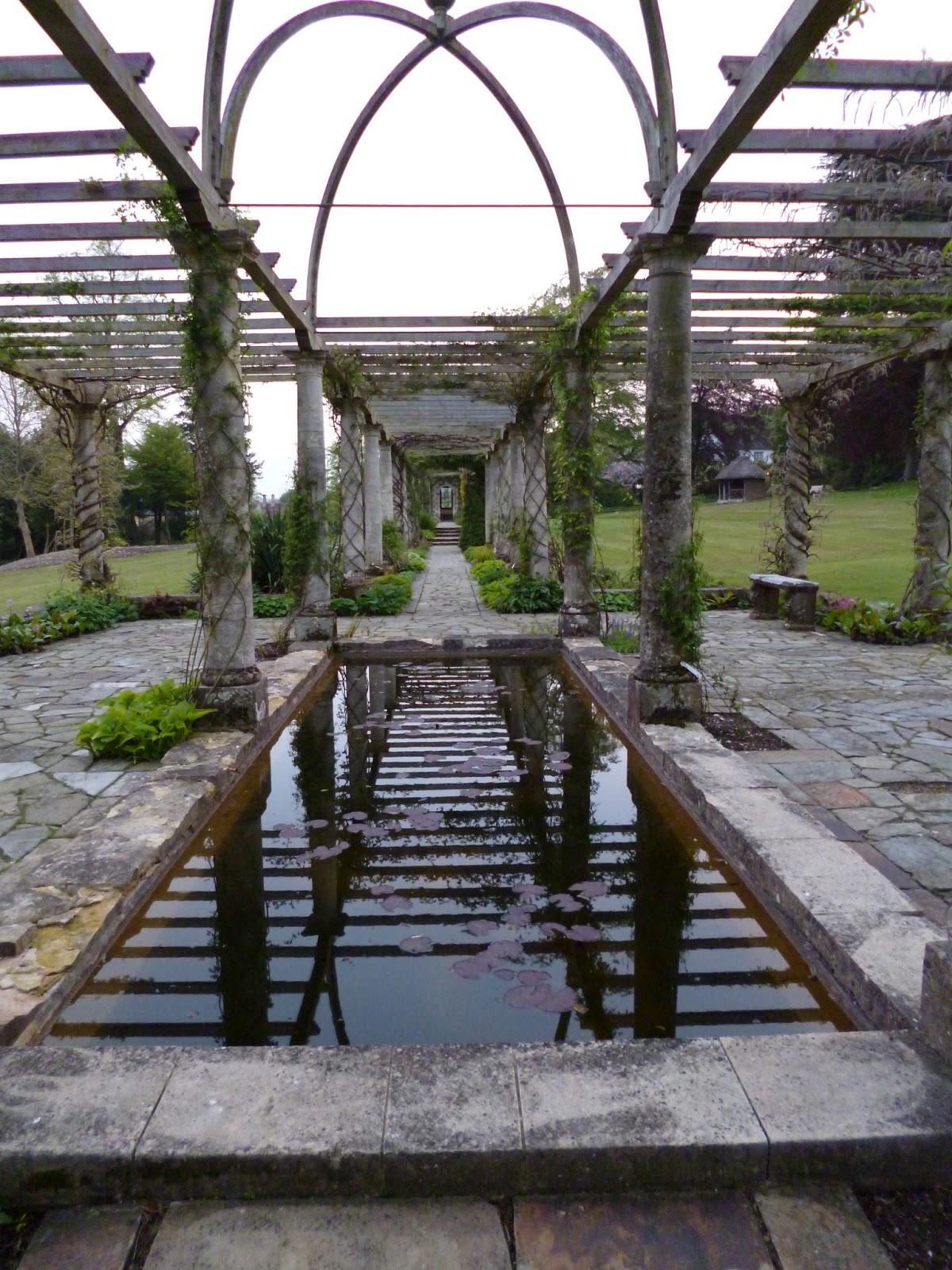
Saturday evening a late stroll through the long pergola and another trip around the Spring Gardens.  No one else around - just me and the birds starting to settle down for the night.  And a couple of bats.


And inside ...


Our workroom:


Inspired by Julie's work we were making brooches, 'creatures', flowers, toadstools, and houses.

My 'creature' pinned together in the planning process:


All sewn up and just the face to do.  A tip from Julie: use small scraps of fabric or thread to work out where you want the facial features,  before committing them in stitch.  The smile on her face reflects the happiness I felt in finally finishing her.


Displays of the group's work at the end of the weekend.  My brooch, creature, toadstool, and toadstool house:


Flowers and creatures by the workshop participants:


All in all a wonderful weekend and I highly recommend doing a workshop at West Dean at least once in your life.


Thursday, 28 March 2013

Royal School of Needlework - Jacobean Crewelwork, Feb 2013

Another weekend course at the RSN at Hampton Court, this time Progress with Jacobean crewelwork with Heather Lewis.


One of the delights of being at Hampton Court is walking through the palace before it's open to the public.  Apart from a few red-coated wardens scurrying to their posts, you find yourself walking through the quiet corridors alone.


One of my favourite sights is walking past the Tudor kitchen while the roaring fire is being built up. 


Our class was in the RSN's degree studios in apartments 7 and 10, which I'd never been in before.  Our studio overlooked the Fountain Court and was reached after a long walk up an old-fashioned winding staircase, complete with winching basket at the top. 


One of the apartments was damaged by a fatal fire in 1996.  The apartments were repaired and repainted, but not redecorated in order to "preserve their 'as-found' quality for future generations".


Anyway, on to the embroidery.  We had a choice of two designs and I chose the parrot.  This is Heather's sample piece and what we were aiming for:


   And here's mine by the end of the two-day course:


We started with trellis stitch for the main body, which I knew was tricky so spent a lot of time on.  Buttonhole stitch for the wing, which is difficult to stitch densely and I'm going to unpick. Long and short stitch for the bottom tail feathers, which I was satisfied with.  The close herringbone stitch for the other tail feather will be unpicked too.  More easy, surprisingly, was the padded satin stitch for the crown and beak, and the burden stitch for the shoulder of the wing.  Raised stem band for the branch was also quite easy.

Saturday, 23 March 2013

Wool House, Somerset House

A return visit to the Wool House at Somerset House, this time with a camera.


Selvedge Spring Fair 2013

The second fair held at Chelsea Old Town Hall and much quieter than the winter fair last November.  Where was everyone?  Maybe they visited on Friday, or perhaps the snowy weather, lack of Christmas-present buying, or increased admission charge put them off. 


The Chelsea buns were nice!